Questions CKS Exam | CKS Dumps Free
Wiki Article
P.S. Free 2026 Linux Foundation CKS dumps are available on Google Drive shared by Pass4Leader: https://drive.google.com/open?id=1nM9EbEq5MQ9lsaV9WYj49lGJIg4VdS7O
In the world in which the competition is constantly intensifying, owning the excellent abilities in some certain area and profound knowledge can make you own a high social status and establish yourself in the society. Our product boosts many advantages and varied functions to make your learning relaxing and efficient. The client can have a free download and tryout of our CKS Exam Torrent before they purchase our product and can download our study materials immediately after the client pay successfully.
In the matter of quality, our CKS practice engine is unsustainable with reasonable prices. Despite costs are constantly on the rise these years from all lines of industry, our CKS learning materials remain low level. That is because our company beholds customer-oriented tenets that guide our everyday work. The achievements of wealth or prestige is no important than your exciting feedback about efficiency and profession of our CKS Practice Engine. So our CKS practice materials are great materials you should be proud of and we are!
No Internet? No Problem! Prepare For Linux Foundation CKS Exam Offline
If you fail in the exam, we will refund you in full immediately at one time. After you buy our Certified Kubernetes Security Specialist (CKS) exam torrent you have little possibility to fail in exam because our passing rate is very high. But if you are unfortunate to fail in the exam we will refund you immediately in full and the process is very simple. If only you provide the scanning copy of the CKS failure marks we will refund you immediately. If you have any doubts about the refund or there are any problems happening in the process of refund you can contact us by mails or contact our online customer service personnel and we will reply and solve your doubts or questions timely.
Linux Foundation Certified Kubernetes Security Specialist (CKS) Sample Questions (Q15-Q20):
NEW QUESTION # 15
You need to implement a container image vulnerability scanning solution within your Kubernetes cluster. You want to use an external vulnerability scanner API that provides information about vulnerabilities in container images- Explain how you would design and implement this solution.
Answer:
Explanation:
Solution (Step by Step) :
1. choose Vulnerability Scanner:
- Select a reputable vulnerability scanner API that provides a comprehensive database and accurate information about container image vulnerabilities.
- Some options include Aqua Security, Anchore Engine, Snyk, Twistlock, and more.
- Choose a scanner with a suitable API interface for integration with your Kubernetes environment.
2. Implement a Scanner Service:
- Create a Kubernetes service that will communicate with your chosen vulnerability scanner API.
- This service will act as an intermediary between Kubernetes and the external scanner
- The service should be able to:
- Accept image details (registry, image name, tag) as input.
- Send requests to the scanner API to retrieve vulnerability information.
- Process the results from the scanner and format them for Kubernetes.
- (Optional) Store the scan results for future analysis and reporting.
3. Design Scanner Workflow:
- You can trigger scans using different methods:
- Automated Scanning: Implement a mechanism (e.g., a cron job or webhook triggered by image pushes) to automatically scan new images.
- On-Demand Scanning: Allow users to manually request image scans via a command line interface (CLI) or a user interface.
4. Integration with Kubernetes:
- You can integrate your scanner service with Kubernetes using several approaches:
- Admission Webh00k1 Use a wet)h00k to intercept pod creation or updates. The webh00k can send the image details to your scanner service and block pod creation if critical vulnerabilities are detected.
- Custom Resource Definitions (CRDs): Create CRDs to manage image scanning tasks- You can define a "ImageScan" or "Vulnerabilityscan" resource that represents a scan request.
- Deployment Controller: Use a custom controller or operator to manage the scanning process. This allows you to define rules for automatic scanning
and integrate with other Kubernetes resources.
5. Scanner Service Implementation (Example):
- Here's a simplified example using Python and a hypothetical "vulnerability-scanner" APC
python
import requests
import json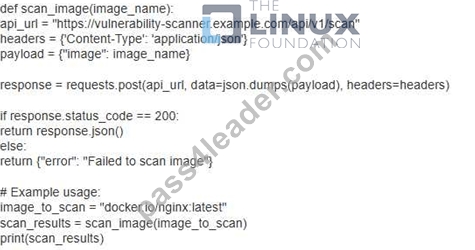
6. Handle Scan Results: - After scanning, process the vulnerability information received from the API. - You can: - Store the scan results in a database or log file. - Generate alerts or reports based on the severity of vulnerabilities found. - Integrate with other security tools or dashboards for analysis and remediation.
NEW QUESTION # 16
Create a PSP that will prevent the creation of privileged pods in the namespace.
Create a new PodSecurityPolicy named prevent-privileged-policy which prevents the creation of privileged pods.
Create a new ServiceAccount named psp-sa in the namespace default.
Create a new ClusterRole named prevent-role, which uses the newly created Pod Security Policy prevent-privileged-policy.
Create a new ClusterRoleBinding named prevent-role-binding, which binds the created ClusterRole prevent-role to the created SA psp-sa.
Also, Check the Configuration is working or not by trying to Create a Privileged pod, it should get failed.
Answer:
Explanation:
Create a PSP that will prevent the creation of privileged pods in the namespace.
$ cat clusterrole-use-privileged.yaml
---
apiVersion: rbac.authorization.k8s.io/v1
kind: ClusterRole
metadata:
name: use-privileged-psp
rules:
- apiGroups: ['policy']
resources: ['podsecuritypolicies']
verbs: ['use']
resourceNames:
- default-psp
---
apiVersion: rbac.authorization.k8s.io/v1
kind: RoleBinding
metadata:
name: privileged-role-bind
namespace: psp-test
roleRef:
apiGroup: rbac.authorization.k8s.io
kind: ClusterRole
name: use-privileged-psp
subjects:
- kind: ServiceAccount
name: privileged-sa
$ kubectl -n psp-test apply -f clusterrole-use-privileged.yaml
After a few moments, the privileged Pod should be created.
Create a new PodSecurityPolicy named prevent-privileged-policy which prevents the creation of privileged pods.
apiVersion: policy/v1beta1
kind: PodSecurityPolicy
metadata:
name: example
spec:
privileged: false # Don't allow privileged pods!
# The rest fills in some required fields.
seLinux:
rule: RunAsAny
supplementalGroups:
rule: RunAsAny
runAsUser:
rule: RunAsAny
fsGroup:
rule: RunAsAny
volumes:
- '*'
And create it with kubectl:
kubectl-admin create -f example-psp.yaml
Now, as the unprivileged user, try to create a simple pod:
kubectl-user create -f- <<EOF
apiVersion: v1
kind: Pod
metadata:
name: pause
spec:
containers:
- name: pause
image: k8s.gcr.io/pause
EOF
The output is similar to this:
Error from server (Forbidden): error when creating "STDIN": pods "pause" is forbidden: unable to validate against any pod security policy: [] Create a new ServiceAccount named psp-sa in the namespace default.
$ cat clusterrole-use-privileged.yaml
---
apiVersion: rbac.authorization.k8s.io/v1
kind: ClusterRole
metadata:
name: use-privileged-psp
rules:
- apiGroups: ['policy']
resources: ['podsecuritypolicies']
verbs: ['use']
resourceNames:
- default-psp
---
apiVersion: rbac.authorization.k8s.io/v1
kind: RoleBinding
metadata:
name: privileged-role-bind
namespace: psp-test
roleRef:
apiGroup: rbac.authorization.k8s.io
kind: ClusterRole
name: use-privileged-psp
subjects:
- kind: ServiceAccount
name: privileged-sa
$ kubectl -n psp-test apply -f clusterrole-use-privileged.yaml
After a few moments, the privileged Pod should be created.
Create a new ClusterRole named prevent-role, which uses the newly created Pod Security Policy prevent-privileged-policy.
apiVersion: policy/v1beta1
kind: PodSecurityPolicy
metadata:
name: example
spec:
privileged: false # Don't allow privileged pods!
# The rest fills in some required fields.
seLinux:
rule: RunAsAny
supplementalGroups:
rule: RunAsAny
runAsUser:
rule: RunAsAny
fsGroup:
rule: RunAsAny
volumes:
- '*'
And create it with kubectl:
kubectl-admin create -f example-psp.yaml
Now, as the unprivileged user, try to create a simple pod:
kubectl-user create -f- <<EOF
apiVersion: v1
kind: Pod
metadata:
name: pause
spec:
containers:
- name: pause
image: k8s.gcr.io/pause
EOF
The output is similar to this:
Error from server (Forbidden): error when creating "STDIN": pods "pause" is forbidden: unable to validate against any pod security policy: [] Create a new ClusterRoleBinding named prevent-role-binding, which binds the created ClusterRole prevent-role to the created SA psp-sa.
apiVersion: rbac.authorization.k8s.io/v1
# This role binding allows "jane" to read pods in the "default" namespace.
# You need to already have a Role named "pod-reader" in that namespace.
kind: RoleBinding
metadata:
name: read-pods
namespace: default
subjects:
# You can specify more than one "subject"
- kind: User
name: jane # "name" is case sensitive
apiGroup: rbac.authorization.k8s.io
roleRef:
# "roleRef" specifies the binding to a Role / ClusterRole
kind: Role #this must be Role or ClusterRole
name: pod-reader # this must match the name of the Role or ClusterRole you wish to bind to apiGroup: rbac.authorization.k8s.io apiVersion: rbac.authorization.k8s.io/v1 kind: Role metadata:
namespace: default
name: pod-reader
rules:
- apiGroups: [""] # "" indicates the core API group
resources: ["pods"]
verbs: ["get", "watch", "list"]
NEW QUESTION # 17
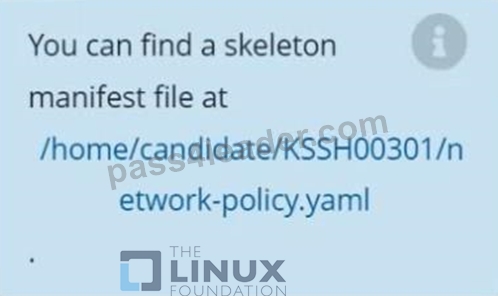
Task
Create a NetworkPolicy named pod-access to restrict access to Pod users-service running in namespace dev-team.
Only allow the following Pods to connect to Pod users-service: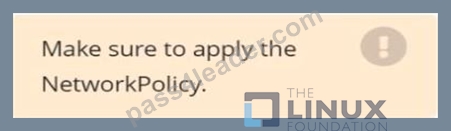
Answer:
Explanation: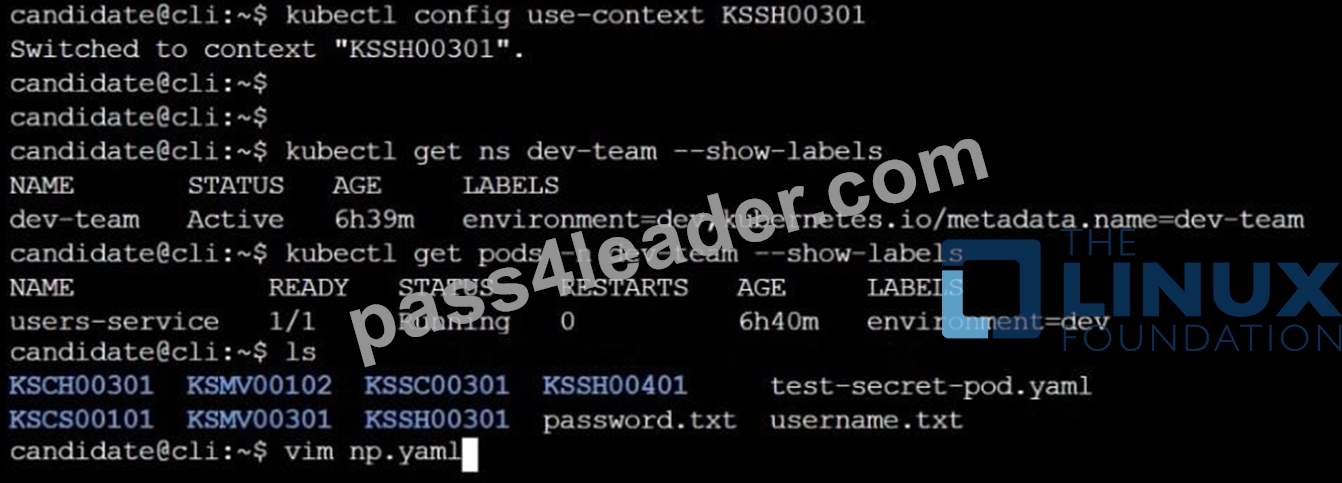
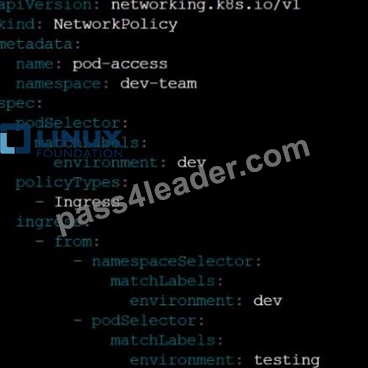
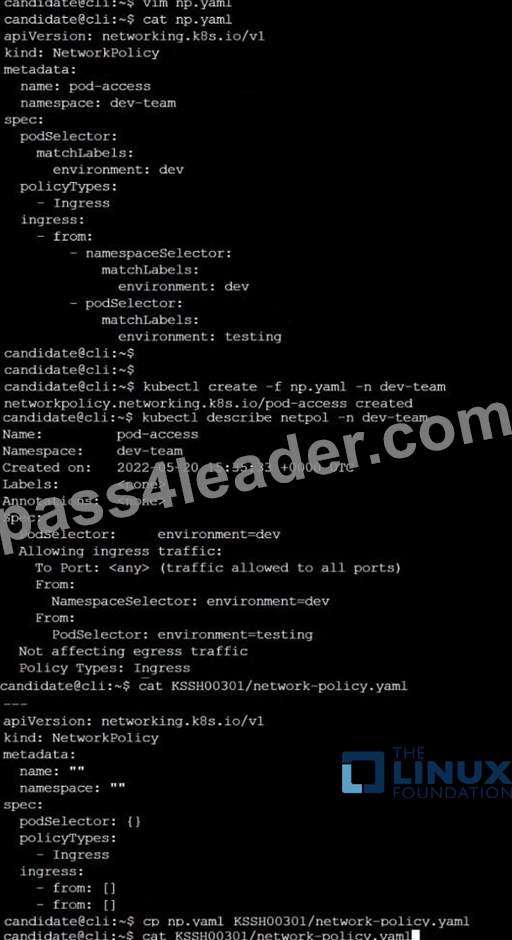
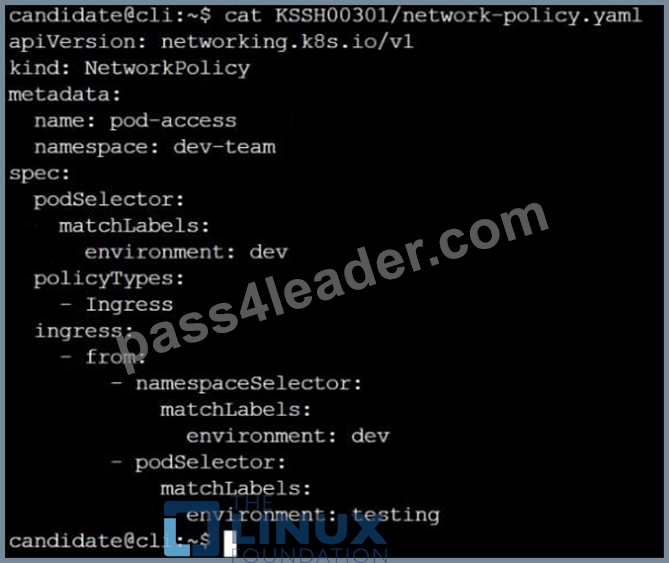
NEW QUESTION # 18
Create a PSP that will only allow the persistentvolumeclaim as the volume type in the namespace restricted.
Create a new PodSecurityPolicy named prevent-volume-policy which prevents the pods which is having different volumes mount apart from persistentvolumeclaim.
Create a new ServiceAccount named psp-sa in the namespace restricted.
Create a new ClusterRole named psp-role, which uses the newly created Pod Security Policy prevent-volume-policy
Create a new ClusterRoleBinding named psp-role-binding, which binds the created ClusterRole psp-role to the created SA psp-sa.
Hint:
Also, Check the Configuration is working or not by trying to Mount a Secret in the pod maifest, it should get failed.
POD Manifest:
apiVersion: v1
kind: Pod
metadata:
name:
spec:
containers:
- name:
image:
volumeMounts:
- name:
mountPath:
volumes:
- name:
secret:
secretName:
Answer:
Explanation:
apiVersion: policy/v1beta1
kind: PodSecurityPolicy
metadata:
name: restricted
annotations:
seccomp.security.alpha.kubernetes.io/allowedProfileNames: 'docker/default,runtime/default' apparmor.security.beta.kubernetes.io/allowedProfileNames: 'runtime/default' seccomp.security.alpha.kubernetes.io/defaultProfileName: 'runtime/default' apparmor.security.beta.kubernetes.io/defaultProfileName: 'runtime/default' spec:
privileged: false
# Required to prevent escalations to root.
allowPrivilegeEscalation: false
# This is redundant with non-root + disallow privilege escalation,
# but we can provide it for defense in depth.
requiredDropCapabilities:
- ALL
# Allow core volume types.
volumes:
- 'configMap'
- 'emptyDir'
- 'projected'
- 'secret'
- 'downwardAPI'
# Assume that persistentVolumes set up by the cluster admin are safe to use.
- 'persistentVolumeClaim'
hostNetwork: false
hostIPC: false
hostPID: false
runAsUser:
# Require the container to run without root privileges.
rule: 'MustRunAsNonRoot'
seLinux:
# This policy assumes the nodes are using AppArmor rather than SELinux.
rule: 'RunAsAny'
supplementalGroups:
rule: 'MustRunAs'
ranges:
# Forbid adding the root group.
- min: 1
max: 65535
fsGroup:
rule: 'MustRunAs'
ranges:
# Forbid adding the root group.
- min: 1
max: 65535
readOnlyRootFilesystem: false
NEW QUESTION # 19
Your organization has a policy requiring all Kubernetes deployments to utilize Pod Security Policies (PSPs) to enforce security best practices. You're responsible for creating a PSP that enforces the following:
- Only allows containers with a specific security context (privileged: false, runAsUser: 1000, readOnlyRootFilesystem: true)
- Restricts access to most resources by denying the 'hostPort and 'hostNetwork' capabilities.
- Prohibits the use of privileged containers.
Implement the required PSP configuration
Answer:
Explanation:
Solution (Step by Step) :
1. Create a PodSecurityPolicy:
- Define a PodSecurityP01icy named 'secure-policy' that enforces the specified security restrictions.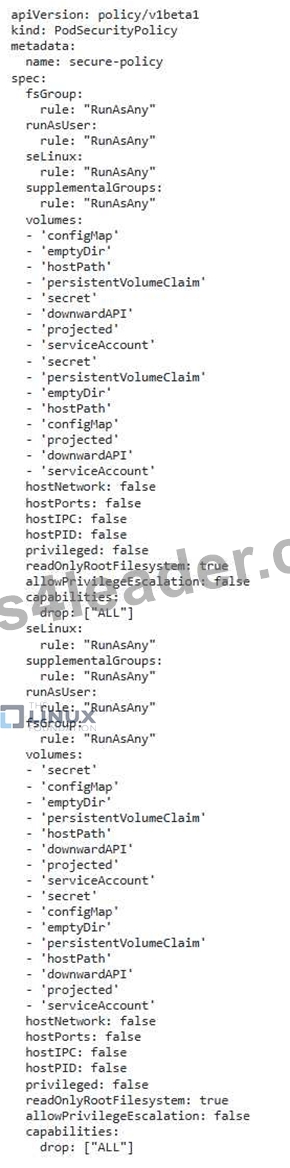
2. Create a PodSecurityPolicy8inding: - Bind the 'secure-policy' to a namespace or specific deployments. - This ensures that the PSP is enforced for deployments Within the bound scope.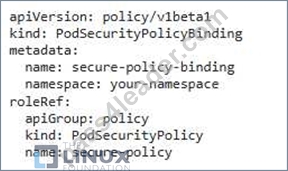
3. Deploy the PSP: - Apply the 'secure-policy.yaml and 'secure-policy-binding.yaml files to the cluster - This will activate the PSP and enforce the defined security rules. 4. Validate PSP Enforcement - Attempt to create a deployment that violates the PSP rules. - Verifry that the deployment creation fails due to the PSP enforcement.
NEW QUESTION # 20
......
To ensure a more comfortable experience for users of CKS test material, we offer a thoughtful package. Not only do we offer free demo services before purchase, we also provide three learning modes for users. Even if the user fails in the Certified Kubernetes Security Specialist (CKS) exam dumps, users can also get a full refund of our CKS quiz guide so that the user has no worries. With easy payment and thoughtful, intimate after-sales service, believe that our CKS Exam Dumps will not disappoint users. Last but not least, our worldwide service after-sale staffs will provide the most considerable and comfortable feeling for you in twenty -four hours a day, as well as seven days a week incessantly.
CKS Dumps Free: https://www.pass4leader.com/Linux-Foundation/CKS-exam.html
There are a lot of advantages of CKS training guide for your reference, Linux Foundation Questions CKS Exam We all known that most candidates will worry about the quality of our product, In order to guarantee quality of our study materials, all workers of our company are working together, just for a common goal, to produce a high-quality product, Because we have all our experts' dedication to the customer & CKS dumps torrent questions with friendly innovations.
You can force the sort to pick up the first row by selecting Questions CKS Exam the entire range before choosing Sort from the Data menu, but you've still inconvenienced yourself, This chapter from Quality Code provides a reasoned approach to testing CKS Dumps Free and clears away some of the questions about testing strategy so that testing techniques can be used effectively.
Excel in the Certification Exam With Real Linux Foundation CKS Questions
There are a lot of advantages of CKS training guide for your reference, We all known that most candidates will worry about the quality of our product, In order to guarantee quality of our study materials, all CKS workers of our company are working together, just for a common goal, to produce a high-quality product;
Because we have all our experts' dedication to the customer & CKS dumps torrent questions with friendly innovations, You do not need to be confused anymore, because our CKS learning materials have greater accuracy compared with same-theme products.
Our CKS exam cram materials will be the shortcut for you.
- CKS Certification Dumps ???? Free CKS Braindumps ???? CKS Practice Test ???? Search for ( CKS ) and easily obtain a free download on ⏩ www.pdfdumps.com ⏪ ????100% CKS Accuracy
- CKS PDF Questions [2026]-Right Preparation Material ???? Open ▛ www.pdfvce.com ▟ and search for ▛ CKS ▟ to download exam materials for free ????Exam CKS Actual Tests
- Free PDF 2026 CKS: Certified Kubernetes Security Specialist (CKS) –The Best Questions Exam ???? Search for 《 CKS 》 and download it for free immediately on ▶ www.prepawayexam.com ◀ ????100% CKS Accuracy
- CKS PDF Questions [2026]-Right Preparation Material ???? Open ➽ www.pdfvce.com ???? enter ⇛ CKS ⇚ and obtain a free download ????CKS Certification Dumps
- CKS PDF Questions [2026]-Right Preparation Material ???? Search for ▛ CKS ▟ and download exam materials for free through ⏩ www.dumpsmaterials.com ⏪ ????CKS Certification Dumps
- CKS Detailed Answers ???? Cost Effective CKS Dumps ???? CKS Test Sample Online ???? Copy URL ▶ www.pdfvce.com ◀ open and search for ▷ CKS ◁ to download for free ????CKS Practice Test
- 2026 Pass-Sure Linux Foundation Questions CKS Exam ???? Copy URL ➥ www.prep4sures.top ???? open and search for ➽ CKS ???? to download for free ❣100% CKS Accuracy
- 100% Pass Quiz Linux Foundation - CKS - Updated Questions Certified Kubernetes Security Specialist (CKS) Exam ???? Copy URL ⇛ www.pdfvce.com ⇚ open and search for ➡ CKS ️⬅️ to download for free ????Exams CKS Torrent
- Relevant CKS Questions ???? CKS Test Sample Online ???? CKS Detailed Answers ???? Search for ➤ CKS ⮘ and easily obtain a free download on ▶ www.prep4sures.top ◀ ????CKS Vce Download
- Linux Foundation - Trustable Questions CKS Exam ???? Download “ CKS ” for free by simply searching on ▛ www.pdfvce.com ▟ ????CKS Valid Test Answers
- Latest CKS Practice Questions ???? Upgrade CKS Dumps ☯ Cost Effective CKS Dumps ???? The page for free download of ⮆ CKS ⮄ on “ www.practicevce.com ” will open immediately ????CKS Certification Dumps
- bookmarkextent.com, funbookmarking.com, haarisudus630999.celticwiki.com, goodlifewithsukanya.com, louisezpdv793375.blogpayz.com, www.stes.tyc.edu.tw, thebookpage.com, bookmarkingalpha.com, wildbookmarks.com, my-social-box.com, Disposable vapes
BTW, DOWNLOAD part of Pass4Leader CKS dumps from Cloud Storage: https://drive.google.com/open?id=1nM9EbEq5MQ9lsaV9WYj49lGJIg4VdS7O
Report this wiki page